How to Launch a Crypto Derivatives Brokerage in 2026
A practical roadmap for futures, perpetual-style instruments, liquidity, risk controls, broker operations and deployment—from architecture to go-live.

Crypto is no longer a market that brokers can treat as an optional asset class.
In 2026, digital assets are increasingly integrated into the broader financial system, while the way clients trade them is becoming more sophisticated. Spot trading remains important, but much of the market's activity has shifted toward derivatives: perpetual futures, dated futures, options and other leveraged instruments.
For brokers, fintech companies and established financial brands, that creates a clear opportunity.
The question is no longer whether it is possible to build a crypto trading offering. The more relevant question is how quickly a company can launch one — without spending a year building a trading engine, terminal, back office, APIs and liquidity infrastructure from scratch.
With the right technology stack, the technical side of a crypto derivatives brokerage can now be deployed within weeks.
For the broader launch sequence—from jurisdiction and business model to go-live—see ScaleTrade's guide to launching a crypto broker. This article focuses specifically on the derivatives infrastructure and operating decisions.
Crypto Derivatives Are Becoming Core Market Infrastructure
Crypto trading has evolved far beyond buying and selling Bitcoin on spot exchanges.
Institutional and professional market participants increasingly use derivatives for leverage, hedging, basis trading, portfolio management and volatility strategies. Perpetual futures in particular have become one of the defining products of the digital asset market.
Coinbase Institutional describes perpetual futures as the largest venue for global crypto trading activity by a wide margin. In 2026, the market has also continued to move closer to traditional financial infrastructure. CME Group announced 24/7 trading for cryptocurrency futures and options, while regulated access to perpetual-style products continues to develop in major markets.
This matters for brokers because derivatives create a fundamentally different client proposition.
Instead of offering a narrow crypto spot product, a brokerage can build a trading environment around:
- Bitcoin and Ethereum derivatives;
- perpetual futures and perpetual-style instruments;
- dated crypto futures;
- crypto CFDs where permitted;
- crypto indices and baskets;
- selected altcoin-linked instruments;
- cross-asset trading alongside Forex, equities, indices, commodities and traditional futures.
The opportunity becomes even more significant when crypto is not isolated in a separate terminal.
A client who comes to trade BTC or ETH can also access other asset classes from the same account and the same interface.
That is where multi-asset brokerage infrastructure becomes particularly valuable.
Why 2026 Is a Different Market for Crypto Brokers
Launching a crypto brokerage several years ago often meant choosing between two difficult options.
The first was to build proprietary technology: trading servers, market-data infrastructure, terminals, risk management, back office, APIs, integrations and mobile applications.
That required significant engineering resources and a long development cycle.
The second was to assemble the brokerage from multiple external vendors — one provider for the trading platform, another for CRM, another for payments, another for liquidity, and additional systems for reporting, KYC and automation.
That approach could reach the market faster, but created another problem: infrastructure fragmentation.
In 2026, neither extreme is necessary.
Modern brokerage platforms can provide the underlying trading infrastructure as an integrated system while still allowing the broker to control its branding, liquidity relationships, execution model, data and product configuration.
This is particularly relevant in crypto, where markets operate continuously and product demand can change extremely quickly.
When a new instrument or market segment gains traction, waiting months for a development cycle can mean missing the opportunity entirely.
What You Actually Need to Launch a Crypto Derivatives Broker
A trading terminal alone does not create a brokerage.
A production crypto derivatives operation requires several layers working together.
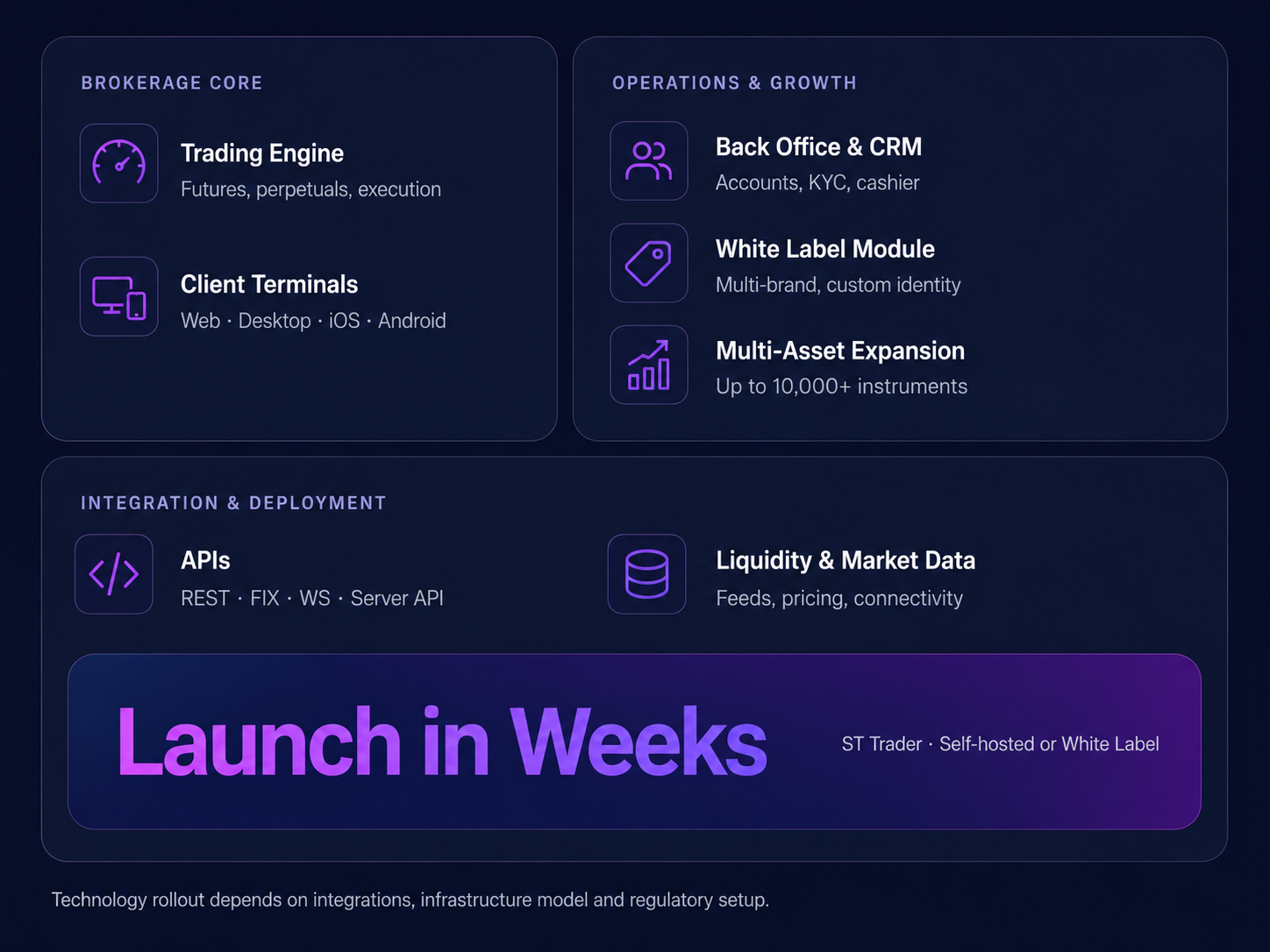
1. Trading Engine
The trading server is responsible for order processing, position management, margin calculations, pricing and execution logic.
Crypto markets operate around the clock, so stability and performance are especially important. Unlike traditional markets, there is no weekend shutdown that naturally creates a maintenance window.
ScaleTrade's trading platform is designed around a high-performance trading engine with low-latency execution and support for large instrument universes.
2. Crypto Liquidity and Market Data
The platform must be able to receive price feeds and connect the brokerage to the required liquidity environment.
Depending on the broker's business model, this may involve liquidity providers, exchanges, institutional counterparties or a combination of external execution and internal risk management.
FIX connectivity and platform APIs become especially important here because they allow the broker to integrate external execution, pricing and proprietary systems without rebuilding the core trading platform.
3. Risk and Exposure Management
Crypto volatility makes risk architecture particularly important.
The broker needs visibility into client exposure, symbol-level risk, account groups, margins and trading activity, with the ability to configure different conditions for different instruments and customer segments.
This becomes even more important when the same platform combines crypto derivatives with Forex, equities, indices or futures.
A multi-asset environment should consolidate risk rather than create separate operational silos for every asset class.
4. Client Trading Terminals
Modern crypto traders expect more than a desktop terminal.
A competitive brokerage should provide access across web, desktop and mobile environments, with features such as:
- advanced charting;
- market and pending orders;
- Stop Loss and Take Profit;
- one-click trading;
- customizable workspaces;
- real-time quotes;
- trading history;
- market watch;
- alerts and analytical tools.
ScaleTrade provides branded trading interfaces across web, desktop, iOS and Android, allowing the broker to operate the client experience under its own brand.
5. Back Office, CRM and Client Operations
Execution is only one part of the brokerage.
Client onboarding, account management, KYC workflows, deposits and withdrawals, manager permissions, communication and reporting all need to connect to the trading environment.
Running these operations through multiple disconnected systems increases both operational workload and integration complexity.
ScaleTrade combines the trading platform with back-office and CRM capabilities, allowing brokerage operations to run within a more unified technology stack.
6. APIs and Integrations
No serious brokerage remains completely isolated.
Payment providers, liquidity sources, KYC vendors, proprietary applications, analytical tools and internal systems may all need access to the trading infrastructure.
ScaleTrade provides REST, WebSocket, FIX and Server API connectivity, giving brokers the ability to extend the platform rather than being limited to its default interface.
Learn more about the Client API, FIX API and custom development and integrations.
From Crypto-Only Broker to a 10,000+ Instrument Brokerage
One of the more important strategic decisions is whether to build a crypto-only brokerage at all.
A client acquired through Bitcoin or Ethereum does not necessarily want to trade only cryptocurrency.
The same trader may also be interested in:
- NASDAQ and S&P 500 instruments;
- technology stocks;
- gold and commodities;
- major Forex pairs;
- index derivatives;
- traditional futures;
- other leveraged products.
This makes the ability to expand the product universe a major commercial advantage.
ScaleTrade supports a universe of 10,000+ trading symbols across crypto, Forex, equities, futures and CFDs within the same platform infrastructure.
That means a company can enter the market with a focused crypto proposition and later expand without moving clients to another system or operating multiple independent platforms.
For the broker, this changes the economics of client acquisition.
Instead of acquiring a customer for one product, the brokerage can potentially retain that customer across multiple market cycles and asset classes.
Explore more industry insights in the ScaleTrade Blog.
How Quickly Can a Crypto Brokerage Be Launched?
This is where modern infrastructure changes the traditional broker-launch timeline.
The core ScaleTrade environment can be deployed rapidly because the broker is not starting with a blank development project.
The trading engine, terminals, back office, APIs and core operational modules already exist.
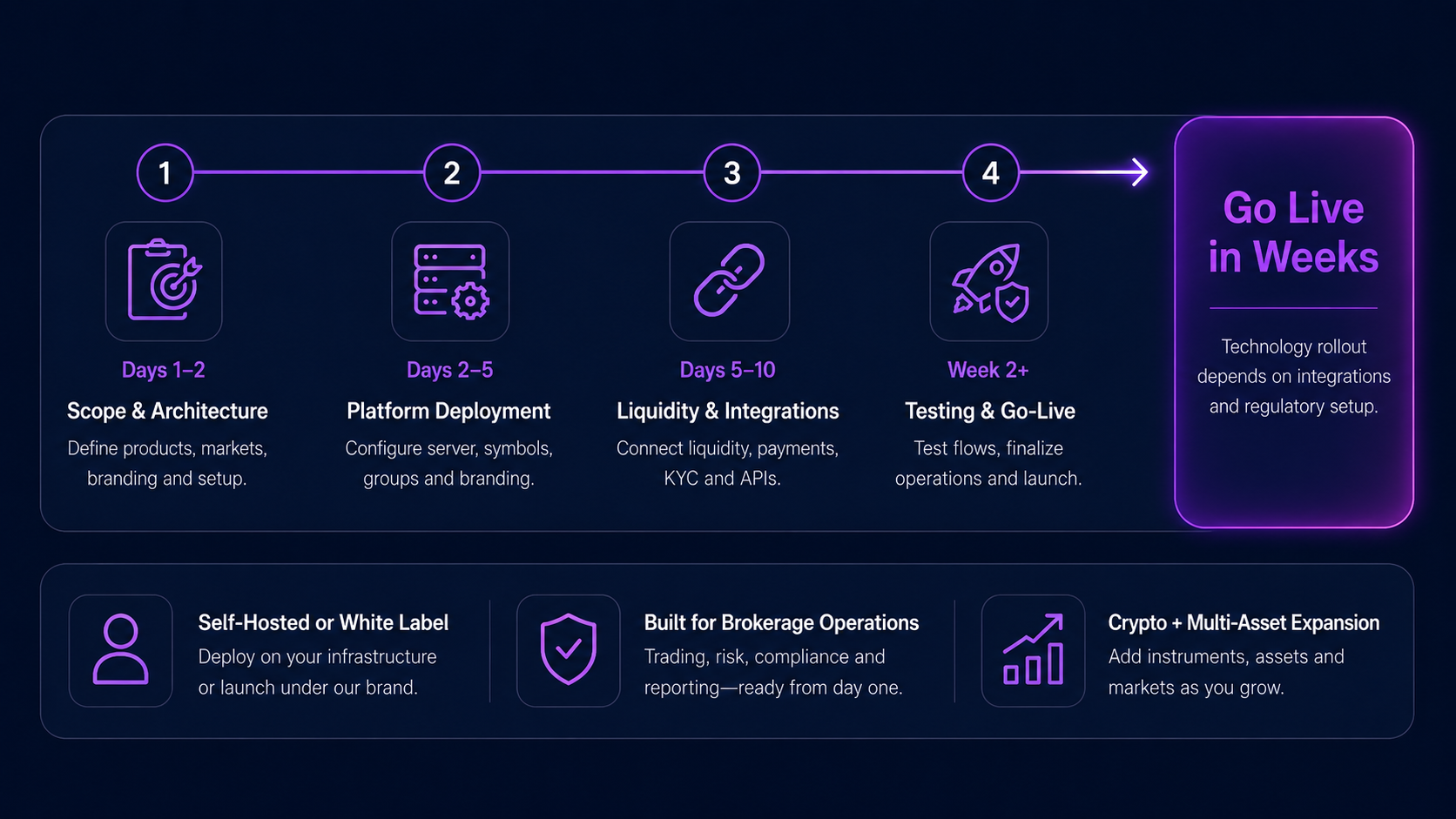
Days 1–2: Scope and Architecture
Define the target markets, crypto products, execution model, liquidity setup, branding, account structure and integrations.
Days 2–5: Platform Deployment and Configuration
Deploy the trading environment, configure trading groups, symbols, server settings and broker branding.
Days 5–10: Liquidity and Integrations
Connect the required pricing, liquidity, payment and external systems.
Week 2: Testing and Launch Preparation
Test order flows, pricing, margin settings, client onboarding, back-office operations and production infrastructure.
Depending on the deployment model and integration requirements, a broker can therefore have its technology infrastructure ready within approximately one to several weeks.
ScaleTrade's standard self-hosted deployment is designed around a roughly one-week technical rollout, while managed White Label implementations are typically launched within one to two weeks.
Custom integrations, regulatory requirements, liquidity onboarding and third-party vendor approvals can extend the overall commercial launch timeline.
The important distinction is that the trading technology no longer needs to be the part of the project that takes months.
White Label or Self-Hosted?
There are two practical routes for launching.
White Label: Optimize for Speed
A White Label setup is suitable when the priority is rapid market entry.
The broker receives a branded environment with trading terminals, market data and operational tools while ScaleTrade manages the underlying infrastructure.
This can be especially attractive for:
- new brokerage businesses;
- fintech companies adding trading services;
- companies testing a crypto product;
- regional broker brands;
- existing firms entering a new market.
Learn more about the ScaleTrade White Label trading platform.
Self-Hosted: Optimize for Control
For brokers that want deeper infrastructure ownership, ScaleTrade can also be deployed on the broker's own servers or cloud environment.
That gives the operator direct control over its trading infrastructure, database, logs, configuration and client data.
A self-hosted model becomes particularly relevant when the business requires proprietary execution logic, data-residency control, deeper liquidity integration or greater technology independence.
Learn more about the ScaleTrade Self-Hosted trading platform.
The two models do not have to represent separate technology strategies. A brokerage can begin with a managed environment and move toward self-hosted infrastructure as the business grows.
Crypto Brokerage Is Becoming a Multi-Asset Business
The strongest opportunity in crypto brokerage may not ultimately be crypto alone.
Digital assets are increasingly becoming another major component of the broader trading ecosystem.
The trader who uses perpetual futures today may trade equity indices tomorrow. The client who arrives because of Ethereum volatility may later trade gold, currencies or traditional futures.
For brokers, the competitive advantage therefore shifts from simply offering crypto to building an infrastructure that can adapt to whichever markets clients want next.
This is why platform capacity matters.
Launching ten instruments is easy.
Launching hundreds or thousands while maintaining execution performance, pricing, account management, APIs and operational control is a different infrastructure problem.
ScaleTrade is designed for exactly that transition — from a focused brokerage product to a scalable multi-asset trading business.
Regulation Still Comes Before Go-Live
Technology can dramatically shorten the platform launch process, but it does not replace the legal and regulatory requirements of operating a brokerage.
The exact structure for offering crypto derivatives depends on the jurisdiction, target clients, instrument type, leverage model, custody structure and execution arrangement.
Licensing, KYC/AML obligations, client categorization, marketing restrictions and product rules should therefore be defined before commercial launch.
ScaleTrade provides the trading technology and infrastructure. The brokerage remains responsible for operating under the regulatory framework applicable to its business.
This distinction is important because a platform may be technically deployable in one or two weeks while the legal establishment of a brokerage takes longer.
The Faster Route to Market in 2026
Building a crypto derivatives brokerage no longer has to begin with building trading software.
The technology already exists.
The real work is defining the product: which instruments to offer, which markets to target, how to structure liquidity and risk, and how to build a client proposition capable of competing in an increasingly sophisticated derivatives market.
With ScaleTrade, a brokerage can combine:
- crypto futures and perpetual-style products;
- a broader universe of 10,000+ trading instruments;
- web, desktop and mobile trading;
- integrated back-office and CRM functionality;
- liquidity connectivity;
- REST, WebSocket, FIX and Server APIs;
- White Label or self-hosted deployment;
- full branding and configurable trading conditions.
Instead of spending months or years developing the underlying trading infrastructure, the broker can focus on the parts that create the business: regulation, distribution, liquidity, client acquisition and product strategy.
Crypto derivatives brokerage launch FAQ
What is a crypto derivatives brokerage?
It gives eligible clients access to instruments derived from crypto assets, such as futures, perpetual-style products, options or CFDs where permitted. Available products depend on the operator's licence, jurisdiction and client category.
What technology does a crypto derivatives broker need?
The core stack includes a trading engine, pricing and liquidity connectivity, margin and exposure controls, client terminals, back office, CRM, payments, KYC workflows, reporting, monitoring and APIs.
How long does the technical rollout take?
A configured platform can be technically deployed within approximately one to several weeks. Licensing, liquidity onboarding, payments, integrations and external approvals can make the commercial launch longer.
Should a broker choose White Label or self-hosted deployment?
White Label prioritizes a faster managed launch. Self-hosted deployment prioritizes direct control over infrastructure, data, configuration and integrations.
Can the brokerage expand beyond crypto?
Yes, if its platform, liquidity setup and licence support additional products. A multi-asset platform can add Forex, equities, indices, commodities, futures or CFDs without maintaining a separate trading core for every asset class.
Ready to Launch a Crypto Trading Brokerage?
If you are planning to launch a crypto derivatives broker, add crypto products to an existing brokerage or replace a fragmented technology stack, ScaleTrade can provide the infrastructure required to move from concept to a live trading environment within weeks.